Apache DataFusion 55.0.0 Released
Posted on: Tue 25 August 2026 by pmc
We are proud to announce the release of DataFusion 55.0.0. This post
highlights some of the many improvements since DataFusion 54.0.0, such as
significant performance increases, range partitioning, MERGE INTO support, and
runtime row-group pruning. The complete list of changes is available in the
changelog. This release represents roughly 10 weeks of development and 877
commits. Thanks to the 175 contributors (a new record!) for making it
possible.
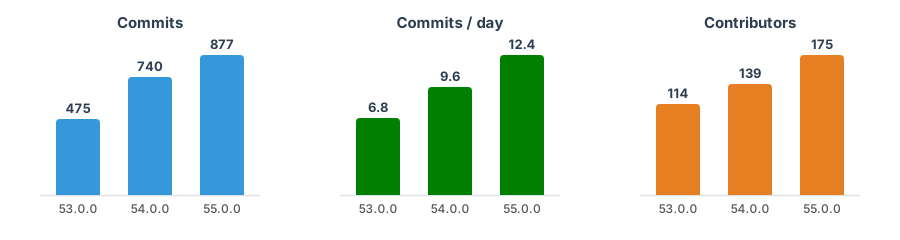
Figure 1: Development activity over the last three DataFusion releases: total commits, commits per day, and unique contributors, computed from each release's changelog and release dates.
Performance Improvements 🚀
In this release, we focused our optimizations on making DataFusion faster across the board rather than further optimizing our very satisfying ClickBench numbers (DataFusion is already the fastest in some cases — see the appendix), as ClickBench represents only a tiny fraction of what our actual users do (e.g. its files have no page index and contain only integer and string columns).
Here is a representative sample of the performance improvements in this release; see the full list in the appendix.
| Improvement | Representative Result | Area |
|---|---|---|
| Runtime row-group pruning for TopK | 4.2x faster topk_tpch Q8 |
Sort / TopK |
Faster IN list evaluation |
up to 14.7x faster for small primitive lists, 9.7x faster for UInt8 |
Expressions |
| Prune unread Parquet leaves for nested columns | Reduces reads from 1.35 TB to 30.9 GB in a production Comet query | Scan / IO |
| Fewer object store requests for CSV | 70% faster TPC-H CSV with simulated latency | Scan / IO |
Faster SortPreservingMerge tie-breaker |
8% faster sort_tpch Q6 |
Sorting |
Native GROUP BY on FixedSizeBinary (e.g. UUIDs) |
~5% faster grouping 200M UUIDs, much less memory | Aggregation |
Sort Pushdown + TopK Pruning
The multi-release Sort Pushdown effort continues to optimize ORDER BY and
ORDER BY ... LIMIT (TopK) queries. In DataFusion 55, as a dynamic filter
threshold tightens, the Parquet reader re-evaluates the threshold against the
remaining row groups and drops those that can no longer contribute (#22450),
and compound ORDER BY queries are now supported. Together these reduce the
total topk_tpch suite runtime by ~43%; see our
Optimizing for Almost Sorted Data blog post for more details. Thanks to
@zhuqi-lucas for driving this work, with reviews from @adriangb.
Aggregation Improvements
Complete Multi-Column GROUP BY Type Coverage:
DataFusion's column-wise GROUP BY storage (GroupValuesColumn) has
type-specific fast paths, but previously any unsupported column type forced
the entire grouping onto a slower row-encoded fallback. For example, this
query to deduplicate a table of UUIDs used to hit the slow path:
SELECT count(*) FROM (SELECT uuid, id FROM 'uuids.parquet' GROUP BY uuid, id);
DataFusion 55 completes the type coverage (#22715), so the query above now runs about 5% faster on 200M UUIDs, and uses much less memory (see #23645). Thanks to @zhuqi-lucas, @tohuya6, and @maxburke for this work.
Faster Functions
DataFusion ships hundreds of built-in functions, so speeding them up improves performance
for many workloads. This release optimizes dozens of functions — up to 24x faster
for find_in_set and 100x for approx_distinct
with low-cardinality inputs and many groups (#22768). It also includes
dictionary-encoding preservation for many string functions (#23743,
#23930, #24100) and new IN list specializations, such as bitmap filters for small integer types (#19241). See the
full list in the appendix.
Thanks to the many contributors who drove this work, especially
@andygrove, @geoffreyclaude, @neilconway, @lyne7-sc, @theirix, and
@haohuaijin.
Planner Improvements
Unified Distribution and Sorting Enforcement:
The EnforceDistribution and
EnforceSorting physical optimizer passes are
now merged into a single EnsureRequirements pass with idempotent sort
pushdown (#21976), fixing longstanding ordering issues between the two passes
and enabling the sort pushdown work described above.
Thanks to @zhuqi-lucas for this work, with reviews from @2010YOUY01 and
@alamb.
Smarter Join Planning:
DataFusion 55 now converts inner joins to more efficient semi joins when equivalent (#22652),
eliminates LEFT/RIGHT joins with redundant sides (#23566), handles
intermediate projections in outer join elimination (#22534), and reorders
predicates in conjunctions using a cost heuristic (#22343).
Thanks to @neilconway and @simonvandel for driving this work.
Better Scalar UDF Metadata APIs:
Scalar UDFs can now declare that they are strict (they return NULL when any
input is NULL) (#23148), letting the optimizer eliminate outer joins for
queries that filter on a function result, and strictly order preserving
(sorted input yields identically sorted output) (#23807), letting the
optimizer eliminate redundant sorts on expressions such as custom casts.
Thanks to @lyne7-sc and @rluvaton for this work, with reviews from
@alamb, @kosiew, and @getChan.
Faster Optimizer:
The optimizer continues to get faster, with improvements such as selective
subquery traversal and in-place rewrites (#22298), collapsing chained
projections (#22389), avoiding re-inlining expensive common subexpressions
(#23459), and a faster PushDownFilter rule that modifies plans in place
rather than copying them (#20002, #21668).
Thanks to @adriangb, @Dandandan, @fordN, and @joroKr21 for this work.
Scan Improvements
Pruning Unread Parquet Leaves for Nested Columns:
Systems that embed DataFusion — such as DataFusion Comet, delta-rs, and
Iceberg integrations — often hand DataFusion a table schema that includes only the nested
subfields the query needs. For example, given a file whose events column
physically holds four subfields, a table might declare only two of them:
-- events column is ARRAY<STRUCT<id BIGINT, name VARCHAR, payload VARCHAR, trace VARCHAR>>
-- Table definition only refers to the first two subfields, id and name
CREATE EXTERNAL TABLE events (
  events ARRAY<STRUCT<id BIGINT, name VARCHAR>>
)
STORED AS PARQUET LOCATION 'events.parquet';
DataFusion correctly reconciles these schemas, but prior to DataFusion 55, all
four leaves were read from the file and decoded, including the large payload
and trace subfields, which were then thrown away. The Comet project reported
a production query where this extra decoding caused 1.35 TB of reads, whereas
plain Spark read only 30.9 GB for the same pruned schema. DataFusion 55 closes
that gap by not reading the undeclared payload and trace leaves from the
file at all (#24090). Thanks to @mbutrovich for this work, with reviews from
@adriangb.
Other Scan Improvements:
DataFusion 55 also skips loading the page index (and an expensive
ParquetMetaData clone) when a file has no page index (#24150), supports
file-level Parquet row selections (#22940), and lowers the default
repartition_file_min_size from 10 MiB to 1 MiB for better parallelism on
small files (#22439).
Thanks to @alamb, @haohuaijin, and @adriangb.
Stability Improvements 🛡️
The community also improved DataFusion's handling of larger-than-memory aggregate workloads (e.g. #23657, #23965, #24061), building on a refactoring of the aggregation path into dedicated streams (epic #22710). Sorts under memory pressure are more resilient: when a spill merge cannot reserve enough memory, DataFusion now re-spills the largest stream in smaller batches rather than failing (#22945), and caps the merge fan-in to bound memory use (#23066). Thanks to @2010YOUY01, @EmilyMatt, @yinli-systems, @Rachelint, and @pepijnve (who fixed a subtle lost-wakeup bug in the spill pool, #23522) for this work.
New Features ✨
file_row_index() and input_file_name()
DataFusion 55 adds file_row_index (#22604) and input_file_name (#22978) functions
to expose Parquet virtual columns:
> select *, input_file_name(), file_row_index() from '/tmp/foo.parquet';
+---------+-------------------+------------------+
| column1 | input_file_name() | file_row_index() |
+---------+-------------------+------------------+
| 100     | tmp/foo.parquet   | 0                |
| 200     | tmp/foo.parquet   | 1                |
+---------+-------------------+------------------+
Such functions are useful for change data capture, debugging, and Spark-compatible workloads. Thanks to @mbutrovich and @AdamGS for this work (reviving earlier work from @jkylling), with reviews from @adriangb, @comphead, and @niebayes.
Range Partitioning
DataFusion 55 adds native range partitioning support, which maps rows to partitions by key ranges (rather than hash values). Query inputs are often range partitioned in real-world scenarios, such as time-series data written as one file per day or hour. DataFusion uses range partitioning information to avoid expensive repartitioning operations and push more specific dynamic filters to scans.
Data that is range partitioned declares an ordering and a list of split
points. Partition i holds the keys that fall between split point i-1 and
split point i:
ordering     = [date ASC NULLS LAST]
split_points = [(2022-01-01), (2023-01-01)]

partition 0: date < 2022-01-01
partition 1: 2022-01-01 <= date < 2023-01-01
partition 2: date >= 2023-01-01
For more details, please see the documentation for
Partitioning::Range, the planning epic (#22395), and
the design discussion (#21992). Thanks to @gene-bordegaray, @saadtajwar, @peterxcli, @stuhood,
@gmhelmold, @mattp5657, @mithuncy, @JSOD11, @EdsonPetry,
@Rich-T-kid, and @blinding-pixels for driving this substantial community
effort.
MERGE INTO Planner Support
MERGE INTO (SQL:2003) is a widely used DML statement for upsert and
conditional update workloads, and a key building block for table formats such
as Apache Iceberg and Delta Lake. DataFusion 55 adds the logical plan types
(#20763) along with SQL planner and physical planner support, and a new
TableProvider::merge_into hook (#22988) so table implementations can
execute merge operations:
MERGE INTO target t
USING source s
ON t.id = s.id
WHEN MATCHED AND s.deleted THEN DELETE
WHEN MATCHED THEN UPDATE SET name = s.name
WHEN NOT MATCHED THEN INSERT (id, name) VALUES (s.id, s.name);
Built-in table providers do not yet implement the hook, but custom
TableProvider implementations (such as lakehouse table formats) can now plug
in their own merge execution. More MERGE INTO improvements are planned for
upcoming releases; see #20746 for details.
Thanks to @wirybeaver for implementing this feature, with reviews from
@alamb and @kosiew.
Pluggable Spill Backends
DataFusion spills to disk when a query exceeds its memory budget, but the spill
infrastructure was previously hardwired to OS-level temporary files. DataFusion
55 introduces a pluggable SpillFile trait and
TempFileFactory (#21882,
#22230) so hosts can route spill data through their own storage layers — for
example, extensions like ParadeDB can now integrate spilling into the
Postgres buffer pool. Implement TempFileFactory and install
it on the RuntimeEnv:
let runtime = RuntimeEnvBuilder::new()
    .with_disk_manager_builder(
        // register a custom TempFileFactory
        DiskManagerBuilder::default()
            .with_temp_file_factory(Arc::new(MyTempFileFactory::new())),
    )
    .build_arc()?;
let ctx = SessionContext::new_with_config_rt(SessionConfig::new(), runtime);
See the object_store_spill.rs example for a complete implementation that
spills to an ObjectStore such as S3. Thanks to @pantShrey for this work,
with reviews from @alamb.
Extensibility for Distributed Engines
Several new APIs make it easier to build distributed systems such as datafusion-distributed, DataFusion Ballista, and DataFusion Python on top of DataFusion:
- Dynamic filter propagation across network boundaries: new
ExecutionPlan::apply_expressionsandExecutionPlan::dynamic_expressions_producedmethods let engines discover which plan nodes produce dynamic filters and re-wire them across stage boundaries (#24018, #24068). Thanks to @jayshrivastava. FFI_QueryPlanner: foreign libraries can now provide a custom query planner over the FFI boundary — for example, connecting a distributed planner to aSessionContextin Python (#24028). Thanks to @timsaucer.- Self-serializing execution plans: built-in
ExecutionPlans were ported to per-typetry_to_proto/try_from_protohooks (#23494), putting built-in and third-party plans on the same code path. Thanks to @adriangb. - Window accumulator state access:
BoundedWindowAggExeccan now expose finalized accumulator state to an observer callback, enabling incremental / prefix-scan use cases (#24035; see how it is used in Ballista). Thanks to @avantgardnerio, with reviews from @alamb and @timsaucer.
EXPLAIN Improvements
DataFusion 55 adds a Postgres-style EXPLAIN (...) option list (#21768) and
a pgjson output format for EXPLAIN ANALYZE (#21767), making plan output
easier to consume with existing Postgres tooling such as plan visualizers.
EXPLAIN ANALYZE can produce many metrics, and you can narrow them down
explicitly with the METRICS option. For example, to see only row counts for
each plan node, use this:
> EXPLAIN (ANALYZE, METRICS 'rows', LEVEL summary)
  SELECT region_id, sum(amount) FROM orders GROUP BY region_id;

AggregateExec: mode=Single, gby=[region_id@0 as region_id], aggr=[sum(orders.amount)], metrics=[output_rows=5]
  DataSourceExec: file_groups={1 group: [[orders.parquet]]}, projection=[region_id, amount], file_type=parquet, metrics=[output_rows=100.0 K, row_groups_pruned_statistics=1 total → 1 matched, scan_efficiency_ratio=7.83% (28.30 K/361.5 K), ...]
Adding FORMAT pgjson renders the same physical plan and its live metrics as
Postgres-compatible JSON, which can be pasted straight into plan visualizers
such as Dalibo:
> EXPLAIN (ANALYZE, FORMAT pgjson, METRICS 'rows', LEVEL summary)
  SELECT region_id, sum(amount) FROM orders GROUP BY region_id;
[
  {
    "Plan": {
      "Node Type": "AggregateExec",
      "Actual Rows": 5,
      "Plans": [
        { "Node Type": "DataSourceExec", "Actual Rows": 100000, ... }
      ]
    }
  }
]
See the EXPLAIN usage guide for the full option list. Thanks to @adriangb for this work.
New Functions
SQL and Scalar Functions:
DataFusion 55 adds new array math functions array_scale, array_add,
array_subtract, array_sum, and array_avg, plus the higher-order
array_first function. It also includes the new
unnest_outer function (#22100), which preserves
empty inputs as NULLs rather than dropping them, and
approx_distinct now supports more types.
Thanks to @crm26, @SubhamSinghal, @EdsonPetry, @athlcode, and
@mkleen for these contributions.
Spark-Compatible Functions:
The datafusion-spark crate gains new or improved Spark-compatible functions,
including hypot, atan2, weekday, monthname, and concat_ws with array
support, plus a new Spark SQL parser dialect config (#22529).
Thanks to the contributors who drove this work, especially
@KarpagamKarthikeyan, @sjhddh, @JeelRajodiya, @davidlghellin, and
@kumarUjjawal.
Upgrade Guide and Changelog 📖
Upgrading to 55.0.0 should be straightforward for most users, though there are some breaking changes. See the Upgrade Guide for details and migration snippets, and the changelog for the full list of changes.
About DataFusion
Apache DataFusion is an extensible query engine, written in Rust, that uses Apache Arrow as its in-memory format. DataFusion is used by developers to create new, fast, data-centric systems such as databases, dataframe libraries, and machine learning and streaming applications. While DataFusion's primary design goal is to accelerate the creation of other data-centric systems, it provides a reasonable experience directly out of the box as a dataframe library, Python library, and command-line SQL tool.
DataFusion's core thesis is that, as a community, together we can build much more advanced technology than any of us as individuals or companies could build alone. Without DataFusion, highly performant vectorized query engines would remain the domain of a few large companies and world-class research institutions. With DataFusion, we can all build on top of a shared foundation and focus on what makes our projects unique.
How to Get Involved
DataFusion is not a project built or driven by a single person, company, or foundation. Rather, our community of users and contributors works together to build a shared technology that none of us could have built alone.
If you are interested in joining us, we would love to have you. You can try out DataFusion on some of your own data and projects and let us know how it goes, contribute suggestions, documentation, bug reports, or a PR with documentation, tests, or code. A list of open issues suitable for beginners is here, and you can find out how to reach us on the communication doc.
Appendix: ClickBench Results
We try not to get too excited by benchmarks, though it is hard not to get caught up in Benchmaxxing. As noted above, ClickBench covers only a tiny fraction of what our users actually do, and reads local files rather than object storage. Even so, DataFusion now sits at the top of the ClickBench leaderboard for processing partitioned Parquet files, as measured by ClickBench's combined metric. Results vary slightly by engine and instance type, but DataFusion matches other state-of-the-art engines on local files and often significantly exceeds them on object storage. Plenty left to optimize, of course.
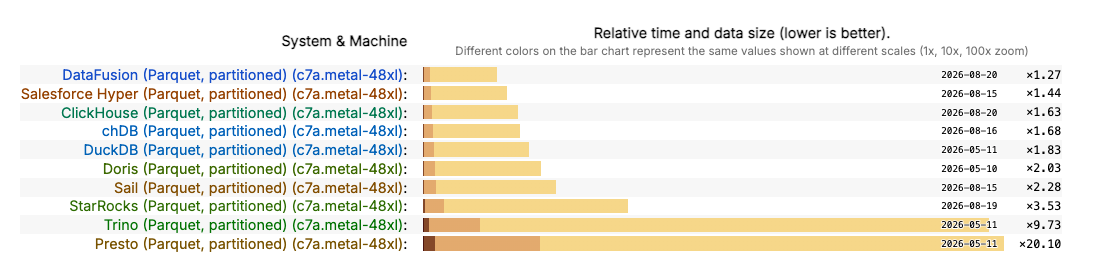 Figure 2: ClickBench results for c7a.metal-48xlarge as of 2026-08-24; DataFusion is the fastest engine for
processing partitioned Parquet files, by ClickBench's combined metric. See the ClickBench results page for the latest results.
Figure 2: ClickBench results for c7a.metal-48xlarge as of 2026-08-24; DataFusion is the fastest engine for
processing partitioned Parquet files, by ClickBench's combined metric. See the ClickBench results page for the latest results.
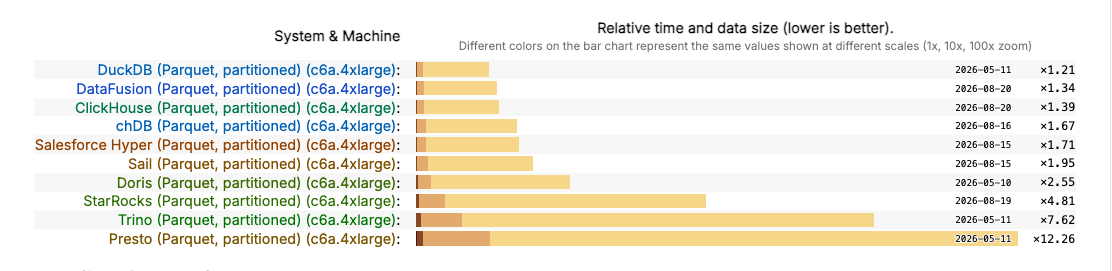 Figure 3: ClickBench results for c6a.4xlarge as of 2026-08-24; DataFusion is the second
fastest engine for processing partitioned Parquet files (combined metric) on this VM type. See the ClickBench results page for the latest results.
Figure 3: ClickBench results for c6a.4xlarge as of 2026-08-24; DataFusion is the second
fastest engine for processing partitioned Parquet files (combined metric) on this VM type. See the ClickBench results page for the latest results.
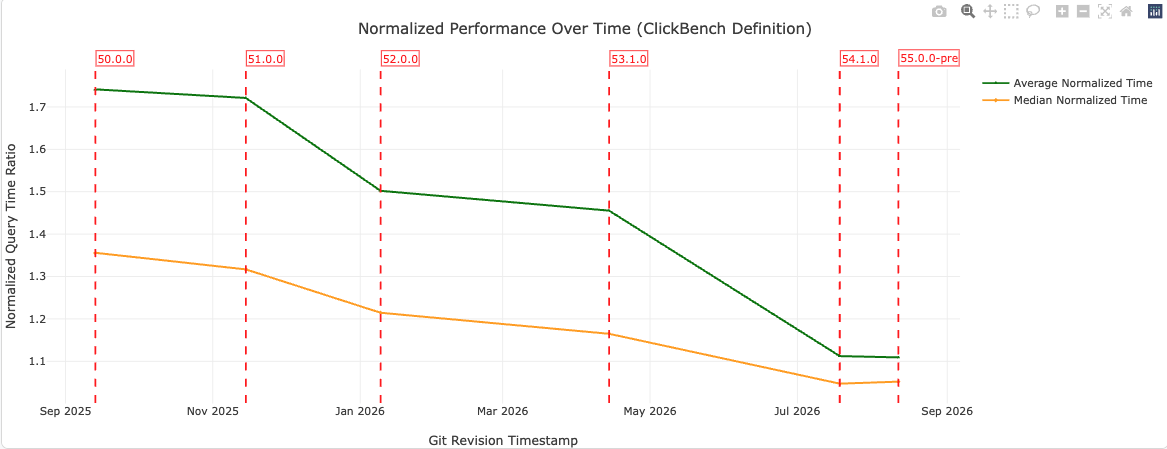
Figure 4: Average and median normalized execution times for DataFusion 55.0.0 on ClickBench queries, compared to previous releases. Query times are normalized using the ClickBench definition. See the DataFusion Benchmarking Page for more details.
Appendix: Full List of Performance Improvements
The tables below list the performance improvements in this release along with a representative measurement for each. Results marked (micro) come from Criterion microbenchmarks and are not expected to translate directly into end-to-end query speedups. Speedups are reported as ratios of old to new runtime: "n% faster" means the old runtime was (100+n)% of the new, and speedups of 2x or more are reported as a multiple.
Sort / TopK
| Improvement | Issue / PR | Representative Result |
|---|---|---|
| Runtime row-group pruning for TopK | #23036, #22450 | 4.2x faster on topk_tpch Q8; 5 of 11 queries 3.6-4.2x faster |
Faster SortPreservingMerge tie-breaker |
#23107 | 8% faster on sort_tpch Q6 |
Window Functions
| Improvement | Issue / PR | Representative Result |
|---|---|---|
LEAD / LAG with IGNORE NULLS |
#23711 | 21.7x faster for List, 10.5x for Utf8View (micro) |
Sliding-window MIN / MAX monotonic deques |
#23827 | up to 3.5x faster (strings; ~2x for numerics) (micro) |
| Skip fully calculated window partitions | #24127 | 49% faster with 32,768 sparse partitions: 161ms → 108ms |
| Skip re-slicing quiet window partitions | #24047 | 26% faster with 32,768 sparse partitions: 209ms → 166ms |
Aggregation
| Improvement | Issue / PR | Representative Result |
|---|---|---|
approx_distinct with many groups |
#22768 | 101x faster: 1723ms → 17ms (Int64, 50K groups) |
array_agg(DISTINCT ...) |
#23716 | 4.0x faster at high cardinality (micro) |
percentile_cont / median |
#23954 | 2.7x faster: 247µs → 92µs (median, window=256) (micro) |
Multi-column GROUP BY type coverage |
#22715, #23523 | 46% less memory for mixed-schema keys: 1096KB → 594KB |
Native GROUP BY on FixedSizeBinary (e.g. UUIDs) |
#23645, #23646 | ~5% faster: 1.13s → 1.07s grouping 200M UUIDs, addressing a reported out-of-memory crash |
| Semi / anti join index alignment | #22794 | TPC-DS Q15 16% faster |
Expressions and Functions
Planning
| Improvement | Issue / PR | Representative Result |
|---|---|---|
| Collapse chained projections | #22389 | 4.0x faster planning: 623ms → 155ms |
| Skip subquery traversal, rewrite in place | #22298 | 29% faster TPC-DS optimization: 220ms → 170ms |
| Don't re-inline CSE'd expensive expressions | #23459 | 67% faster on repeated power(a, 2) |
Skip ensure_distribution rebuild for unchanged children |
#22521 | 2.9x faster per call: 171µs → 59µs |
Unified EnsureRequirements pass |
#21976 | TPC-H: 8 queries faster, 0 slower |
| Predicate reordering heuristic | #22343 | ClickBench Q21 10-13% faster |
Scan / IO
| Improvement | Issue / PR | Representative Result |
|---|---|---|
| Prune unread Parquet leaves for nested columns | #24090 | Reduces reads from 1.35 TB to 30.9 GB in a production Comet query |
| Fewer object store requests for CSV | #22962 | 70% faster on TPC-H CSV with simulated latency |
Lower repartition_file_min_size to 1 MiB |
#22439 | TPC-H Q22 68% faster |
| Skip page index load when the file has none | #24149, #24150 | ClickBench (single file) Q1 38% faster |